
A clean sheet is easy to understand. A team did not concede. The opponent scored zero.
What is harder to understand, and what matters if you want to predict clean sheets before the match, is which signals actually determine whether that happens. Which specific measurable ratings tell you whether a defense is likely to hold.
Our model has a direct answer. Here is how clean sheet probability is calculated, and what you can read from the matchup card before kickoff.
What Is a Clean Sheet in Soccer?
A clean sheet is when a team does not concede any goals during the match. It applies to the 90 minutes of regular time. Extra time and penalties do not count.
A 1-0 win is a clean sheet for the winning team. A 0-0 is a clean sheet for both teams. A 2-1 result means neither team kept one.
In fantasy sports, particularly Fantasy Premier League, defenders and goalkeepers earn 4 bonus points for a clean sheet. This makes clean sheet prediction especially valuable for weekly lineup decisions.
How the Model Calculates Clean Sheet Probability
Clean sheet probability in PredictApp is not a separate calculation. It comes directly from the same score probability matrix that the model uses to calculate BTTS, over/under, and team totals probabilities.
The calculation is mathematically direct:
Home team clean sheet probability = sum of all score probabilities where the away team scores exactly 0 goals.
In other words: P(1-0) + P(2-0) + P(3-0) + P(4-0) + … = home clean sheet probability.
Away team clean sheet probability = sum of all score probabilities where the home team scores exactly 0 goals.
P(0-1) + P(0-2) + P(0-3) + … = away clean sheet probability.
This means clean sheet probability is internally consistent with every other market probability in the model. A high home clean sheet probability and a high BTTS probability cannot coexist. They come from the same score matrix and are mathematically exclusive.
The Two Ratings That Matter Most
Two inputs drive clean sheet probability for any specific match.
The defending team’s defensive weakness (DH or DA).
DH is the home defensive weakness. It measures how easily this team concedes goals at home.
A low DH means the team is defensively solid at their own ground. They do not concede much. That is a good foundation for a clean sheet.
A high DH means they concede regularly at home. Even against average opposition, the risk of conceding is elevated.
DA works the same way for away matches. A team with a low DA is defensively organized on the road. A high DA means they are porous when traveling.
The opponent’s attacking strength (AH or AA).
For a home team clean sheet: the away team’s attacking strength on the road (AA) is the threat. A weak AA means the away team struggles to score when visiting. The home clean sheet becomes more likely.
A high AA means the away team is dangerous on the road regardless of the result. The home defense has to be genuinely solid (low DH) to hold them.
The combination that predicts a clean sheet:
Low defensive weakness + Low opponent attacking strength = high clean sheet probability.
The combination that makes a clean sheet unlikely:
High defensive weakness + High opponent attacking strength = the model expects a goal, clean sheet probability drops significantly.
Both factors need to align. A strong defense against a dangerous attack is not a reliable clean sheet signal. The high opponent AA offsets the low DH.
Why Squad Depth Affects Clean Sheets
RWI ratings capture team-level defensive quality across a season. But within a season, squad depth adds a signal that matters.
Teams with higher squad value tend to maintain defensive quality through rotation. A deep defensive unit can cycle players without a significant drop-off. A thin squad under fixture congestion shows its defensive weaknesses as the season progresses.
Form last 5 matches is the model’s recency signal. A team that has conceded in 4 of its last 5 matches is showing that something has changed from its historical DH rating. The model weights recent form alongside the long-run RWI signal.
Head-to-head history also adds context. Some opponent pairs reliably produce clean sheets for one side. If Team A has kept a clean sheet against Team B in 3 of the last 5 meetings, that tactical matchup history carries meaning.
Clean Sheet and BTTS: Reading Both Signals Together
Clean sheet and BTTS are two sides of the same coin, and they are mutually exclusive for any given team.
If the home team keeps a clean sheet, the away team scored 0 goals. BTTS did not happen. A home clean sheet makes BTTS impossible.
This is why reading both probabilities together are more useful than reading either in isolation.
Example:
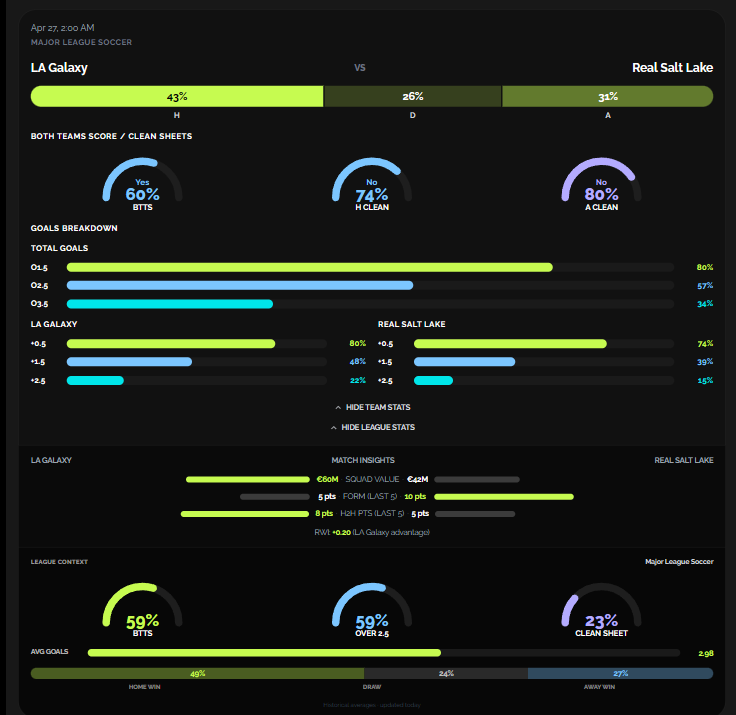
Model shows 26% home clean sheet probability. That means there is a 74% chance the away team scores. That 74% is one of the conditions for BTTS.
Model also shows 60% BTTS probability. The 60% BTTS and 26% home clean sheet are consistent with each other. Both can be true because they describe overlapping parts of the score distribution.
But reading them together tells you something more specific: the home defense is fragile enough that the away team is expected to score (74%), and both sides are expected to score more often than not (60%). That combination points toward a match where the home team scores but also concedes. Think 2-1 or 3-1.
The model is showing you the full picture. Clean sheet probability is not just about whether one team holds. It is part of the full score distribution that tells you what kind of match this is likely to be.
See Clean Sheet Predictions for Today’s Matches
FAQ
What is a clean sheet in soccer?
A team does not concede any goals during the match. Applies to 90 minutes of regular time. Extra time and penalties do not count.
How do you predict a clean sheet?
Check two signals: (1) the defending team’s defensive weakness rating (low DH for home, low DA for away), and (2) the opponent’s attacking strength (low AA for away team threats, low AH for home team threats). Low defensive weakness + weak opponent attack = high clean sheet probability.
What factors affect clean sheet probability?
Defensive weakness (DH/DA), opponent attacking strength (AA/AH), squad value (defensive depth), form last 5 (recent conceding patterns), and head-to-head history with this specific opponent.
Does a clean sheet count if the match goes to extra time?
The market settles at 90 minutes. Goals in extra time do not affect the clean sheet result for the market.
How does defensive strength affect clean sheet probability?
Directly and proportionally. A team with a very low DH facing an opponent with a very low AA has the model’s highest possible clean sheet probability. Both factors need to align. A strong defense against a dangerous attack is not a reliable clean sheet signal.
What is the relationship between clean sheet and both teams to score?
They are mutually exclusive for any given team. A clean sheet by the home team means the away team scored 0. BTTS is impossible. Reading both probabilities together gives a fuller picture of the match’s likely scoring pattern.
Read More
Clean Sheet Hub: Predictions by League
How PredictApp’s Goals Model Works
—
Match analysis is for informational purposes only. Model validated on 39,042 matches.