
What Information Really Matters Before a Match
Before a match, the problem is usually not a lack of data. The problem is knowing which information actually helps and which information just creates noise.
A lot of people listen to too many opinions and get lots of stats, but they don’t have enough structure to interpret them. They see a recent result, a big club name, or a convenient narrative and assume they have the game figured out. Usually, they do not.
A more useful read starts when you organize the right information. In PredictApp, that reading is grounded in four signals that actually help explain the matchup before kickoff: RWI, team value, results across the last 5 matches, and recent meetings context.
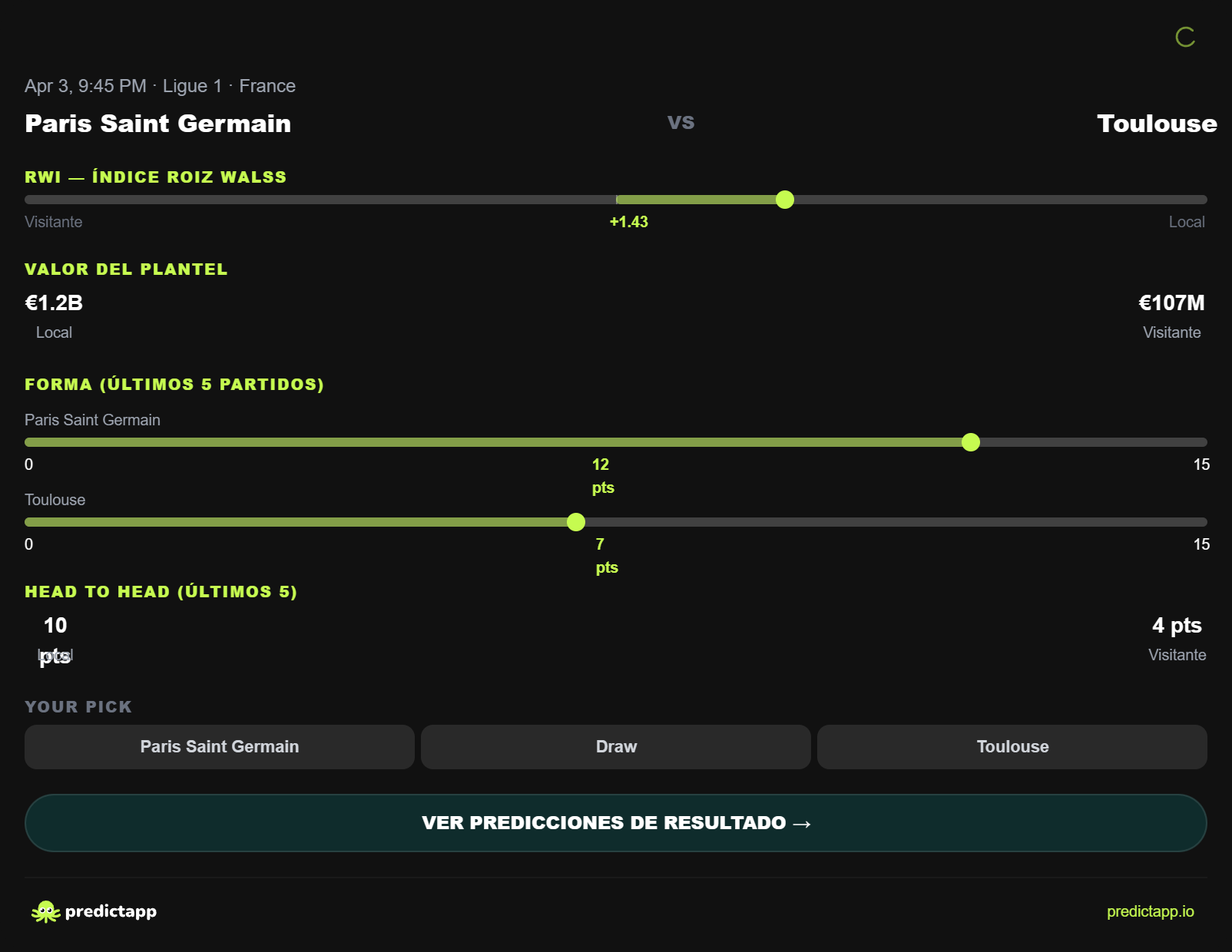
Quick answer
If you want to read a match better before kickoff, focus on signals that help answer four questions:
- what structural edge exists
- how strong each squad looks in value terms
- how each side is arriving based on recent results
- what recent pattern exists between these two opponents
That does not guarantee an outcome. It gives you a more useful way to read the real context around the match.
Not all information matters equally
Before a match, you can always find noise: loose opinions, overplayed narratives, badly read streaks, big headlines, and player-name debates that sound deep without helping.
The question is not “what data exists?” The question is “what data helps me understand this matchup before the whistle?”
You need to separate signal from noise.
1. RWI is the fastest way to understand what the model expects from the match
RWI, the Roiz Walss Index, is one of the most useful signals inside PredictApp’s match analysis view. It summarizes the expected goal difference the model sees before the match.
It is not a standalone prediction, and it does not replace the rest of the context. What it does give you is a clean first view of how the teams compare to each other before the matchup.
The simple way to read it is:
- a more positive value leans toward the home side
- a more negative value leans toward the away side
- a value closer to the middle suggests a more balanced game
What matters is that RWI is not random. It is trying to compress team venue strength, lineup context, home advantage, and league environment into one readable signal.
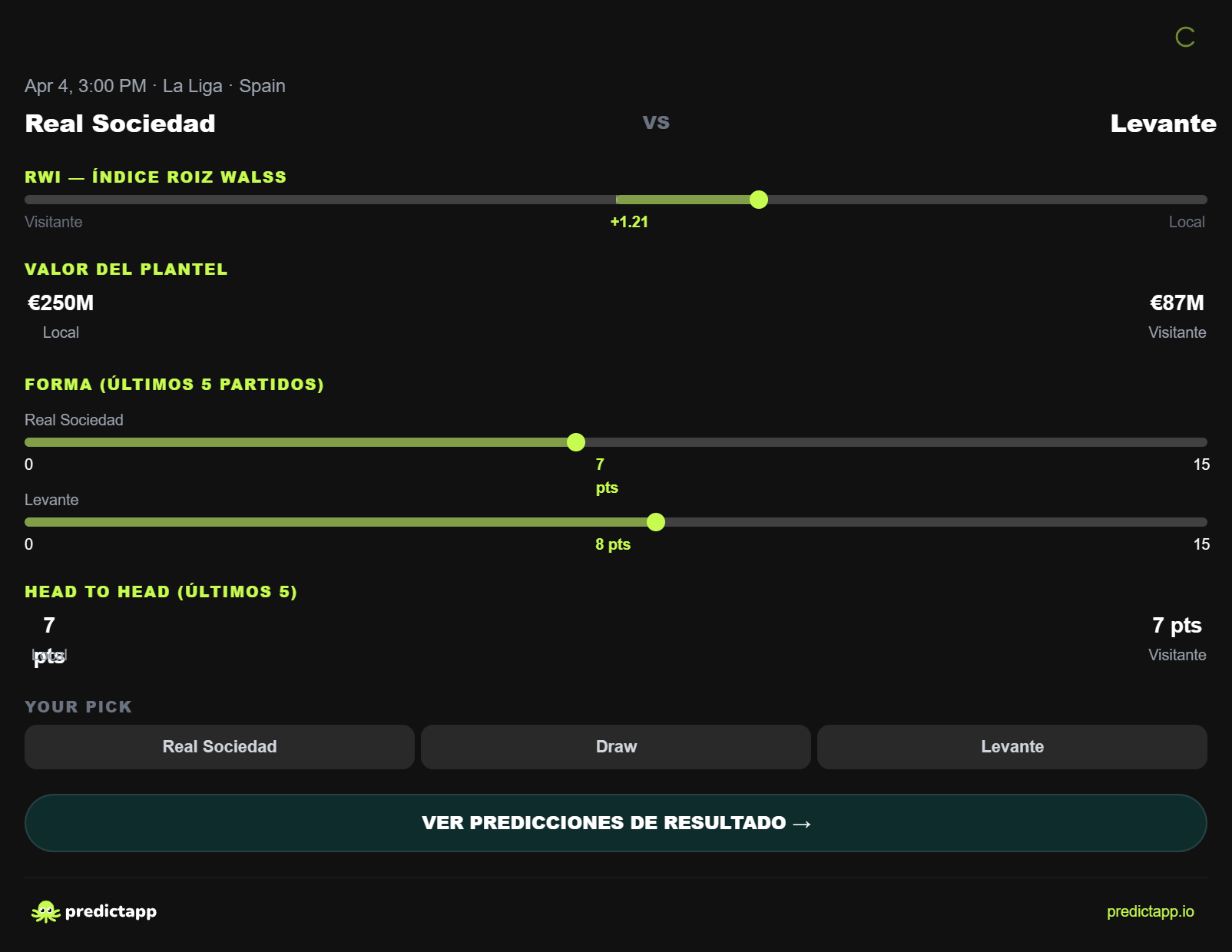
That makes it a strong starting point. It does not tell the whole story, but it helps you understand where to start.
2. Team value is structural context
PredictApp also shows team value in euros.
That matters because team value can work as a structural quality signal. It does not tell you what will happen. It does give you context around the level of talent, depth, and resources each side is working with.
Put simply, if there is a big gap in team value, a team usually has better players. It may reflect depth, top-end quality, or the ability to sustain performance over time. Or it might just be that a team has a couple of superstars that raise the team’s value. This is why you must be careful, maybe the team with 2 superstars and a higher team value does not do better than a balanced team with less team value.
Higher team value does not mean automatic control of the match. The useful move is to combine it with the rest of the card. If team value favors one side, recent results also lean that way, and RWI points in the same direction, then the pre-match read starts to feel more coherent. If one signal points one way and another pushes back, the match deserves more caution.
3. Last-5 results give recent context, not the whole truth
Another useful signal is recent results. PredictApp shows it as points collected across the last 5 matches.
This helps answer a basic question: how is each team arriving to this match?
That matters because recent results can reveal useful patterns:
- one team may be stacking results consistently
- the other may be arriving less stable
- the overall competitive momentum may not be equal
But this signal also should not be read on its own.
Five matches do not explain everything. One team may have taken points against “weaker” opponents. Another may have dropped points against “tougher” ones. There may have been injuries, suspensions, heavy rotation, or schedule distortion. Recent results work best as context.
4. Recent meetings can help when you know how to interpret them
Recent meetings between these two teams also appear in PredictApp’s match analysis view as points collected across their last 5 meetings.
That can add useful context because some opponents repeatedly make life difficult for each other because of style, game state patterns, recent competitive history, or simply a mental effect.
But this also needs judgment.
Head-to-head is not a guarantee. It does not mean the same thing will happen again. What it can do is add another layer:
- it shows whether the recent matchup has been balanced or tilted one way
- it can reveal whether one side has repeatedly neutralized the other’s usual strengths
- it adds context when the other signals are not all pointing in the same direction
The real value comes from reading the signals together
The most useful pre-match read does not come from obsessing over one number.
It comes from looking at how the four signals interact:
- what RWI says
- what the team value gap looks like
- how both teams arrive across the last 5 matches
- what the recent meetings say
For example, if:
- RWI favors the home team
- the home team also has the stronger team value
- recent results are better on that side
- and recent meetings also lean that way
then the pre-match picture looks fairly aligned.
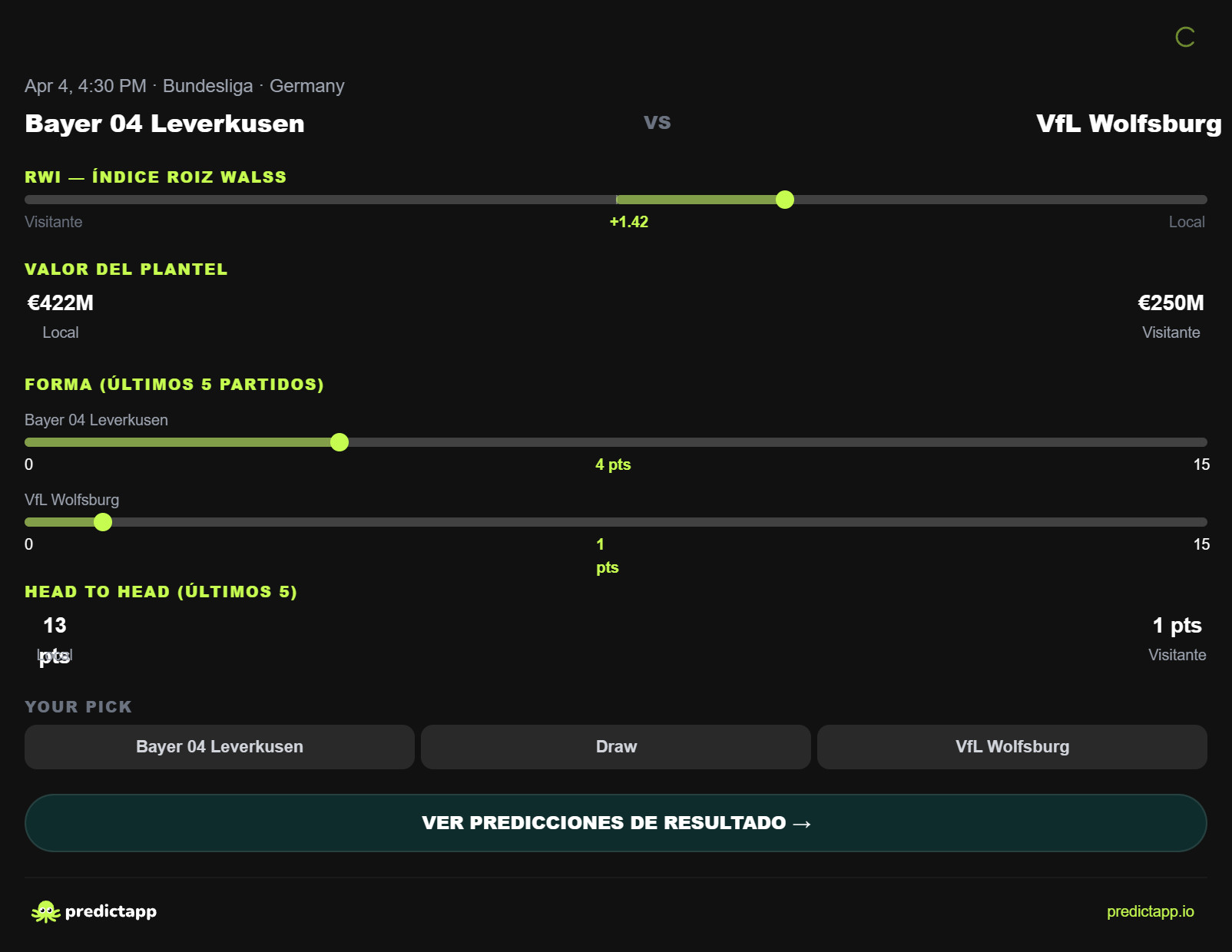
But if team value leans one way while RWI looks more balanced, recent results are weak, and recent meetings are tight, then the match is probably less obvious than it first appears. It might even be a draw.
That is the point of good pre-match analysis. The signals say more together than they do in isolation.
What not to do with this information
Do not use one signal as if it is the whole analysis.
Do not turn an edge into certainty.
Do not read a match only through club name, badge, or a recent narrative if the pre-match signals are telling a different story.
And do not forget that even a disciplined read still lives with uncertainty. Soccer works that way.
How to connect context to probabilities
This matters even more when you read the probabilities on the same screen.
If the home win is 42%, that does not mean the model is telling you “home side will win.” It means home win is the single most likely result. But the combined draw and away win outcomes still make up 58% of the probability.
That is a more useful read.
Instead of treating the top number like fake certainty, you read the full distribution and then use RWI, team value, recent results, and recent meetings to understand why the split looks the way it does.
That is the kind of interpretation PredictApp is built to support.
How PredictApp helps
PredictApp is not trying to overwhelm you with data. The point is to show the information that actually helps you read the match before it starts.
That is why the product brings signals together in one place, including:
- RWI
- team value in euros
- recent results across the last 5 matches
- recent meetings context
- outcome probabilities interpreted as a full three-way distribution, not just a single top result
That gives the user a clearer way to understand the matchup before kickoff. Not to manufacture confidence, but to make better decisions with better context.
FAQ
It is a PredictApp signal that summarizes the expected goal difference the model sees before the match.
No. It helps describe structural team quality, but it should always be read alongside the rest of the match context.
No. It is useful recent context, but by itself it can mislead if you ignore the rest of the matchup.
Yes, if you use it as recent context between these two teams rather than as a magic rule.
Explore predictions by league
You can also go straight into PredictApp’s landing pages for the leagues you care about:
- Soccer Hub
- Liga MX
- Premier League
- Champions League
- La Liga
- Bundesliga
- Serie A
- Europa League
- Ligue 1
- MLS
- Superliga
- Copa Libertadores
- Liga BetPlay
- Liga Profesional de Futbol
- Brasileirao Serie A
Next step
Create a free account and explore PredictApp’s match analysis view with RWI, team value, recent results, and recent meetings in one place: https://app.predictapp.io/